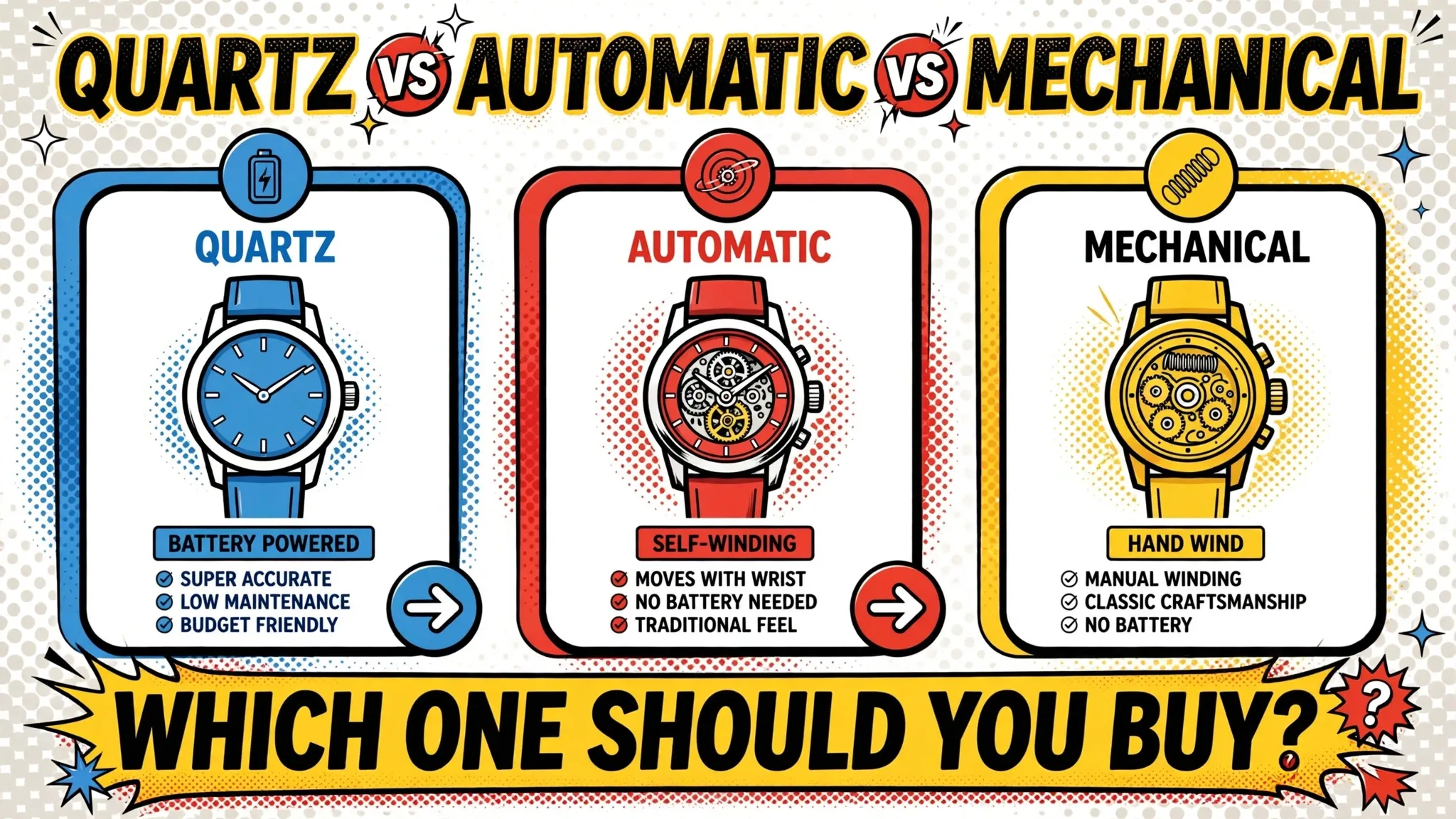
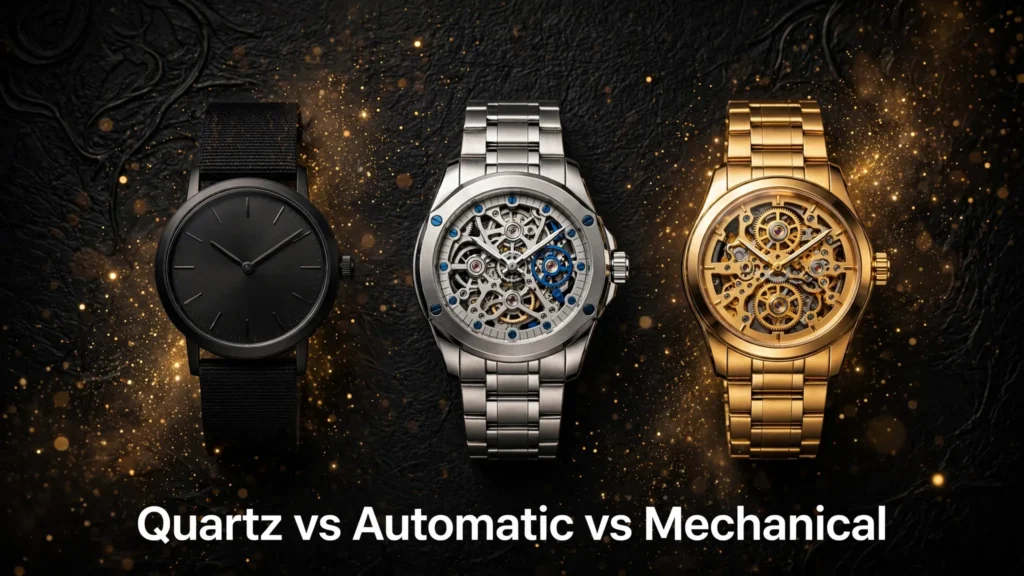
Choosing a watch is one of the most personal decisions you can make. It is not just about telling time; it is about what you value. Do you want perfect accuracy with zero hassle? Do you love the idea of a machine powered by your own movement? Or do you cherish the tradition of winding a watch by hand every morning? In 2026, the debate of Quartz vs Automatic vs Mechanical Watch is more relevant than ever. With rising costs for luxury goods and a growing focus on sustainability, understanding the true differences between these movements is essential before you spend your hard-earned money.
This guide breaks down everything you need to know. We will look at accuracy, maintenance costs, environmental impact, and the best watches to buy right now, using real data from 2026 market trends. Whether you are a first-time buyer looking for a sub-$200 tool watch or an investor eyeing a Rolex, this article will help you decide which movement reigns supreme for your lifestyle.
Understanding the Heart of the Watch: How They Work
To make the right choice, you first need to understand what makes these watches tick. The “movement” is the engine inside the watch, and each type operates on a completely different principle.
The Quartz Movement: Battery Power and Precision
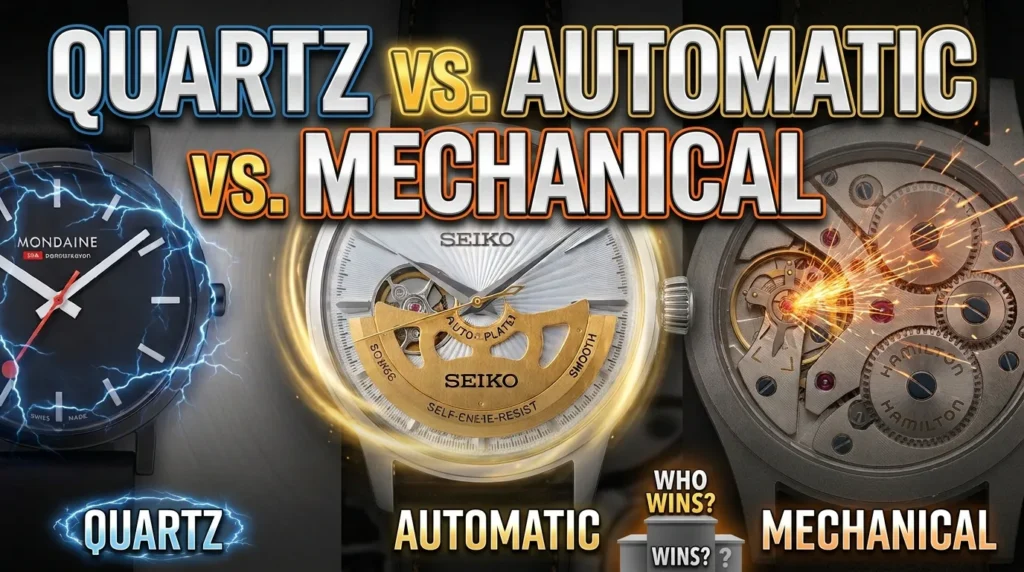
Quartz watches are the modern workhorses of the watch world. Inside a quartz watch, a small battery sends an electrical current through a tiny crystal of quartz. This crystal vibrates at a very specific frequency when electricity hits it. These vibrations are so fast and consistent that they drive the motor to move the hands with incredible precision.
Because they rely on electronics and a battery, quartz watches have very few moving parts. This makes them simple, durable, and highly resistant to shocks. If you drop a quartz watch, it is likely to keep running without issue because there are no delicate gears to break. The second hand on a quartz watch moves in a distinct “tick-tick-tick” motion, jumping once every second.
The Mechanical Movement: Traditional Craftsmanship
Mechanical watches are the opposite of quartz. They do not use batteries or electronics. Instead, they run on pure mechanical energy stored in a coiled spring called a “mainspring”. When you wind the crown of the watch, you tighten this spring. As the spring slowly unwinds, it releases energy through a series of gears to power the watch.
A mechanical movement is a marvel of engineering. A single mechanical watch can have over 130 tiny components, including gears, springs, and jewels that reduce friction. These parts must be hand-assembled with extreme precision. The second hand on a mechanical watch does not tick; it sweeps smoothly around the dial, which many enthusiasts find mesmerizing. However, because they rely on springs and gears, they are more sensitive to shocks and require regular care to keep running smoothly.
The Automatic Movement: The Best of Both Worlds?
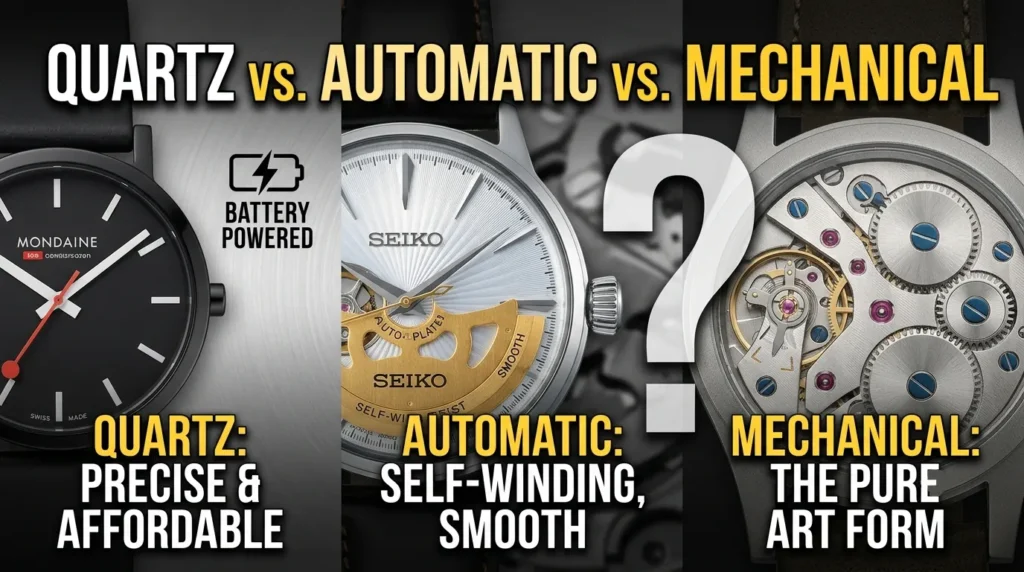
An automatic watch is actually a type of mechanical watch. It has the same mainspring and gears as a manual mechanical watch, but it adds one special component: a rotor. This rotor is a half-circle weight that spins freely inside the watch. When you move your wrist during the day, the rotor spins and automatically winds the mainspring for you.
This means you rarely have to wind an automatic watch by hand, as long as you wear it regularly. If you take it off for a few days, it will stop because the mainspring runs out of power. Most automatic watches have a “power reserve” of 24 to 48 hours, meaning they can run for that long without being worn. Some high-end models can last up to 80 hours or more. Like manual mechanical watches, automatics have that smooth sweeping second hand and the same complex internal architecture.
Accuracy: Which Watch Keeps Time Best?
When people ask about Quartz vs Automatic vs Mechanical Watch, the first thing they usually worry about is accuracy. Will my watch be late for work?
Quartz Wins on Pure Accuracy
There is no contest here: quartz watches are far more accurate than mechanical ones. A standard quartz watch might gain or lose only about 15 seconds per month. Some high-end quartz models are even more precise. This is because the quartz crystal vibrates at a constant rate that is not affected by gravity or position in the same way mechanical parts are.
Mechanical and Automatic Variability
Mechanical and automatic watches are less accurate by nature. A standard automatic watch might gain or lose 20 to 40 seconds per day. This might sound like a lot compared to quartz, but for a mechanical machine with hundreds of moving parts, it is considered normal. The accuracy depends on how the watch is positioned (face up, crown down, etc.) and the temperature.
However, not all mechanical watches are the same. High-end “COSC Certified” chronometers are tested rigorously and must stay within -4 to +6 seconds per day. Brands like Tudor and Longines offer COSC-certified automatics that come very close to quartz accuracy while still offering mechanical beauty. But generally, if your top priority is never having to set the time, quartz is the clear winner.
| Watch Type | Typical Accuracy | Best Case Accuracy |
|---|---|---|
| Quartz | ±15 seconds / month | ±10 seconds / year (High-end) |
| Automatic | ±20 to 40 seconds / day | -4 to +6 seconds / day (COSC) |
| Mechanical | ±20 to 40 seconds / day | -4 to +6 seconds / day (COSC) |
Maintenance and Long-Term Costs: The Hidden Expenses
Buying the watch is just the beginning. To truly understand Quartz vs Automatic vs Mechanical Watch, you must look at the cost of ownership over 10 or 20 years. This is where the differences become very clear.
Quartz Maintenance: Low Cost, Frequent Changes
Quartz watches are cheap to maintain in the short term but have recurring costs. The main task is replacing the battery.
- Frequency: You need to change the battery every 1 to 3 years.
- Cost: A battery replacement typically costs between $10 and $50, depending on where you go.
- Long-term Service: While the battery is the main cost, quartz watches are not immortal. After 10 to 15 years, the lubricants inside can dry out, or the electronic circuit might fail. A full service or movement replacement might cost between $50 and $150.
- 20-Year Estimate: Over 20 years, you might spend $200 to $400 total on a quartz watch.
Automatic and Mechanical Maintenance: High Cost, Rare Service
Mechanical and automatic watches do not need batteries, but they are complex machines that wear down.
- Frequency: They require a full service every 3 to 5 years to clean, oil, and adjust the movement. Some manufacturers say you can wait until you notice performance changes, but regular care is best.
- Cost: This is where it gets expensive. A basic service for an entry-level automatic can cost $150 to $350. For luxury brands like Omega or Rolex, a service can range from $600 to over $1,200.
- Complexity: Servicing a mechanical watch involves taking apart all 130+ components, cleaning them, replacing worn parts, and re-lubricating them.
- 20-Year Estimate: Over 20 years, owning an automatic watch could cost you $600 to $1,200 or more in service fees.
The Verdict on Cost
If you hate surprise bills, quartz is safer. If you view the service cost as part of the hobby and the value of owning a long-lasting machine, mechanical is worth it. Remember, a well-cared-for mechanical watch can last 50 to 100+ years, potentially becoming an heirloom. Quartz watches often have a shorter lifespan of 20 to 30 years before the movement becomes obsolete or too costly to repair.
| Cost Factor | Quartz Watch | Automatic/Mechanical Watch |
|---|---|---|
| Battery/Power | $10–$50 every 1–3 years | $0 (Self-winding/Manual) |
| Service Interval | 10–15 years (Optional) | Every 3–5 years (Required) |
| Service Cost | $50–$150 | $150–$1,200+ |
| 20-Year Total | $200–$400 | $600–$1,200+ |
Environmental Impact: The Eco-Friendly Choice in 2026
In 2026, sustainability is a major factor for buyers. The debate of Quartz vs Automatic vs Mechanical Watch now includes the environment.
The Problem with Quartz Batteries
Quartz watches rely on batteries, usually made of silver oxide or lithium.
- Waste: A typical quartz watch uses 10 to 15 disposable batteries over a 30-year lifetime.
- Toxicity: These batteries contain toxic materials like mercury and lithium. Millions are discarded every year, creating hazardous waste if not recycled properly.
- Production Impact: Making lithium batteries requires mining, which harms ecosystems and uses a lot of water.
The Eco-Case for Mechanical Watches
Mechanical and automatic watches are often seen as the greener choice.
- No Batteries: They generate power from your wrist movement or manual winding. This is a renewable energy source.
- Longevity: Because they can be repaired indefinitely, they do not end up in landfills as quickly. A mechanical watch passed down through generations creates zero waste compared to throwing away multiple quartz watches.
- Sustainable Materials: Many Swiss watchmakers are now using recycled gold and steel, and brands like Panerai and Breitling are using recycled materials in their cases.
Solar Watches: The Middle Ground
If you want the accuracy of quartz but hate batteries, solar watches are a great option. Brands like Citizen and Casio make watches that charge via light.
- Battery Life: A solar watch has a rechargeable cell that lasts 10 to 20 years, eliminating the need for frequent battery changes.
- Impact: This reduces battery waste by up to 70% compared to standard quartz. Citizen Eco-Drive alone has prevented over 100 million batteries from entering landfills.
Price Points: What Can You Buy in 2026?
Your budget will likely dictate your choice in the Quartz vs Automatic vs Mechanical Watch debate. Here is what the market looks like in July 2026.
Entry Level: Under $500
You can get excellent watches in this range.
- Quartz: You can find reliable quartz watches starting as low as $40. Models like the Phantom Steel GMT offer great features for under $40. Fashion brands and entry-level Seikos dominate here.
- Automatic: Getting an automatic under $500 is possible but requires careful selection. Brands like Seiko (Seiko 5 line) and Orient offer solid mechanical watches for $120 to $200. The Seiko 5 Sports SRPD51 is a top pick around $325.
- Mechanical (Manual): The Hamilton Khaki Field Mechanical is a legendary choice for a no-frills tool watch, though prices have risen, it remains a benchmark for quality.
Mid-Range: $500 to $5,000
This is the sweet spot for enthusiasts.
- Quartz: High-end quartz watches from brands like Tissot (e.g., PRX Quartz) start around ₹35,500 (approx. $425). They offer sapphire crystal and premium build quality.
- Automatic: This range is packed with incredible value.
- Tissot: The PRX Powermatic 80 offers an 80-hour power reserve.
- Hamilton: Offers great American heritage with Swiss movements.
- Tudor: The Tudor Black Bay is a “Best Modern Value” pick, starting around £3,910 ($4,900+).
- Grand Seiko: The SBGA401 (Spring Drive) is available around $4,900, offering quartz accuracy with mechanical soul.
- Others: Brands like Behrens offer luxury mechanical watches under $5,000, such as the Orion One at $3,600.
Luxury: Over $5,000
When you cross the $5,000 threshold, you are paying for brand heritage, finishing, and investment potential.
- Rolex: In 2026, a stainless steel Rolex Submariner costs around $10,050, and a GMT-Master II is about $11,800. These are automatic watches known for holding their value.
- Omega: The Seamaster Diver 300M is a top luxury challenger, with service costs around $650-$800.
- Investment: Brands like Patek Philippe and Audemars Piguet sit above Rolex in prestige, with entry prices over $25,000. These are strictly mechanical/automatic and are bought as much for investment as for telling time.
| Budget Range | Best Quartz Option | Best Automatic/Mechanical Option |
|---|---|---|
| Under $500 | Casio Duro ($70) | Seiko 5 Sports ($325) |
| $500 – $5,000 | Tissot PRX Quartz ($425) | Tudor Black Bay ($4,900) |
| Over $5,000 | High-end Citizen Eco-Drive | Rolex Submariner ($10,050) |
Features and Durability: Shock, Water, and Daily Use
How do these watches handle real life?
Shock Resistance
- Quartz: Because they have fewer moving parts, quartz watches are naturally more shock-resistant. You can wear them while playing sports or doing outdoor activities with less worry.
- Mechanical/Automatic: The delicate balance wheel and gears can be damaged by hard impacts. However, modern watches have shock absorbers (like Diashock in Seiko) to help. Still, for rough sports, quartz is generally tougher.
Water Resistance
Both types can be water-resistant.
- Quartz: Often found in dive watches like the Casio Duro ($69.95) which offers 200m water resistance.
- Automatic: Luxury divers like the Omega Seamaster offer 300m water resistance. The build quality of the case matters more than the movement type here.
Daily Convenience
- Quartz: Set it and forget it. Ideal for everyday use where you just want to grab and go.
- Automatic: Requires regular wear. If you have a rotation of watches and don’t wear your automatic daily, it will stop. You might need a “watch winder” to keep it running when not worn.
- Mechanical: Requires daily winding. This ritual is part of the charm for lovers of tradition, but it can be a hassle for others.
Top Recommendations for 2026
Based on current trends and value, here are specific picks for each category.
Best Quartz Watch: Citizen Eco-Drive
For reliability and eco-friendliness, the Citizen Eco-Drive line is unmatched. With 80% of their quartz models using solar power, you eliminate battery waste entirely. The Promaster Diver is ISO-certified and solar-powered, making it a perfect tool watch.
Best Entry Automatic: Seiko 5 Sports
The Seiko 5 Sports line (like the SRPK67 at $325) offers a durable automatic movement, 100m water resistance, and a classic look that punches above its price point. It is the perfect introduction to the sweeping second hand.
Best Value Mechanical: Hamilton Khaki Field
For those who love the ritual of winding, the Hamilton Khaki Field Mechanical is the gold standard. It features a manual winding movement with an 80-hour power reserve in newer models, blending old-school cool with modern convenience.
Best Luxury Investment: Tudor Black Bay
If you want a luxury automatic without the Rolex markup, the Tudor Black Bay (specifically the 58 or GMT models) is the choice. It holds its value well and offers in-house movements.
Best for Sustainability: Mechanical or Solar
If your goal is to reduce your carbon footprint, choose a mechanical watch from a brand using recycled materials (like Breitling or Panerai), or a solar quartz watch from Citizen or Casio to avoid disposable batteries.
The 2026 Trend: Size Matters
A key trend in 2026 is the shift away from huge watches. The era of oversized, chunky watches is out. The most popular case sizes now are between 36mm and 41mm. This sleeker style is more comfortable and works better with tailored clothing. Whether you choose quartz or automatic, looking for a watch in this size range will ensure your purchase feels modern and timeless.
Final Verdict: Which One Should You Buy?
So, in the battle of Quartz vs Automatic vs Mechanical Watch, who wins? The answer depends entirely on you.
Choose Quartz If:
- You want the highest accuracy with the least effort.
- You are on a tight budget (under $100).
- You need a tough watch for sports and outdoor activities.
- You don’t want to worry about servicing costs every few years.
- Tip: Go for Solar Quartz to be eco-friendly.
Choose Automatic If:
- You love the craftsmanship and the smooth sweeping second hand.
- You want a watch that can last a lifetime and be passed down.
- You enjoy the engineering of a self-winding machine.
- You are willing to pay for periodic servicing ($150-$1,200) to maintain it.
- You want a watch that retains or increases in value (like Rolex or Tudor).
Choose Mechanical (Manual) If:
- You cherish the tradition and ritual of winding your watch every morning.
- You prefer a thinner watch case (manual movements are often thinner than automatics).
- You want the purest form of watchmaking art without a rotor.
In 2026, there is no single “best” watch. Quartz offers unbeatable convenience and accuracy. Automatic and mechanical watches offer soul, history, and a connection to the art of timekeeping. By understanding the costs, the maintenance, and the environmental impact, you can make a choice that fits your wrist and your values perfectly. Whether it is a $40 quartz beater or a $10,000 Rolex, the best watch is the one you enjoy wearing every day.
Limitations & Unknowns
While this guide covers the major differences, specific warranty periods vary significantly by brand and model, and comprehensive data on the long-term value retention of every specific mechanical model is not universally available. Additionally, detailed specifications for every new 2026 release may change, so always verify with the official manufacturer before purchasing.
2 thoughts on “Quartz vs Automatic vs Mechanical Watch: Key Differences, Pros, Cons & Which One Should You Buy?”