
I know very well, you are trying to decide between Rado vs Longines in 2026, the choice comes down to what you value most: indestructible modern materials or proven investment stability. Longines is the clear winner for resale value, holding 60-70% of its price on the secondary market, making it the smart choice for “rational investors.” In contrast, Rado dominates in durability; its High-Tech Ceramic cases are 5 times harder than steel and stay scratch-free forever, appealing to “aesthetic innovators” who prioritize comfort and looks over resale. While Longines offers superior movement technology with silicon balance springs and a 72-hour power reserve, Rado provides a unique, lightweight wearing experience that no steel watch can match.
The Big Picture: Two Giants Under One Roof
Both brands share a powerful family connection that guarantees quality, yet they serve very different types of watch lovers.
You might be surprised to learn that both Rado and Longines are owned by the same parent company, the Swatch Group. This is the largest watch manufacturer in the world, also owning famous names like Omega and Blancpain. Being in the same family means both brands benefit from shared technology, strict quality control, and Swiss manufacturing standards. However, within this family, they have very different roles.
Longines positions itself as a brand for “rational investors.” It relies on a long, famous history dating back to 1832. When you wear a Longines, you are wearing a piece of recognized history that appeals to traditionalists. Rado, founded in 1917, targets “aesthetic innovators.” It made history in 1986 as the first brand to successfully use ceramic in watchmaking. In the battle of Rado vs Longines, you are choosing between traditional steel elegance and futuristic material science.
Material Science: The Ceramic King vs. The Steel Standard
The most visible difference between these two brands is the material used for the watch case, which defines their look, feel, and durability.
Rado: The Master of Ceramic
Rado does not just use ceramic; they invented the modern process for it, creating a material that is nearly impossible to scratch.
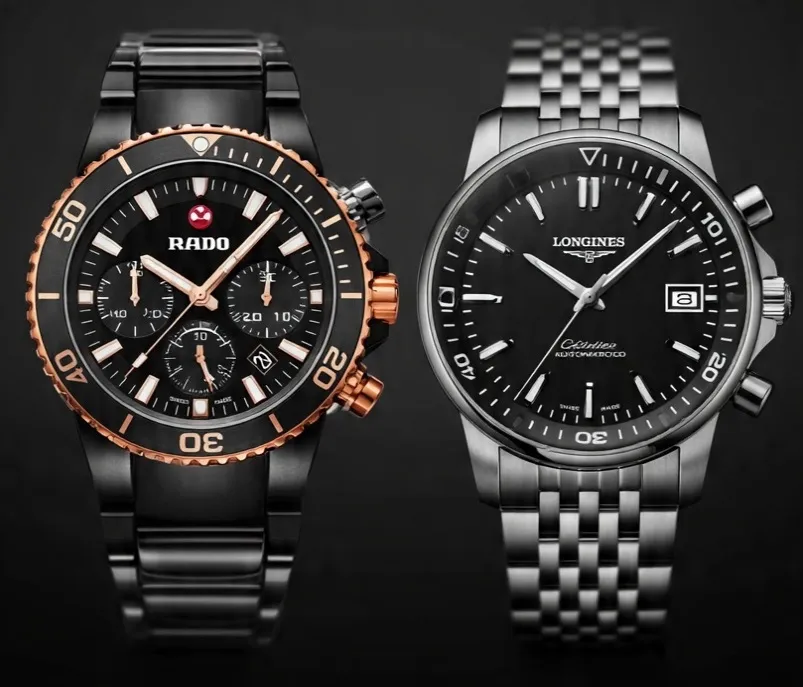
Rado’s signature material is called “High-Tech Ceramic.” It starts as ultra-pure zirconium oxide powder, which is injected into molds at high pressure. This mold is then baked (sintered) at a scorching 1,450°C for 5 to 6 weeks. During this process, the material shrinks by about 23% to become incredibly dense. The result is a case with a hardness of 1,250 Vickers, compared to just 150-200 Vickers for standard stainless steel. This means Rado’s ceramic is roughly 5 times harder than steel and can only be scratched by a diamond.
Beyond hardness, this ceramic is 30% lighter than steel, making Rado watches very comfortable for all-day wear. It is also hypoallergenic, making it perfect for people with sensitive skin. Because the color goes all the way through the material, it never fades or wears off. A 5-year-old Rado often looks brand new because it simply does not get the micro-scratches that ruin the look of steel watches.
Longines: The Strength of Steel
Longines sticks to the classic industry standard of 316L stainless steel, offering a traditional feel that many collectors prefer.
Longines primarily uses 316L stainless steel for its cases, particularly in the popular HydroConquest line. This metal is tough, corrosion-resistant, and has a heft that many watch lovers associate with quality. While steel is softer than ceramic and will scratch over time, it is less brittle. If you hit a ceramic watch hard against a sharp corner, it could crack; steel will likely just dent or scratch, which can be polished out later.
In 2026, Longines has smartly combined these materials. Many new models feature a steel case but include a ceramic bezel insert. This gives you the scratch resistance of ceramic on the part of the watch that gets bumped the most (the rim), while keeping the classic metal feel on the wrist. This approach appeals to those who want a robust, traditional tool watch that can take a beating without the risk of shattering.
Inside the Watch: Movement and Technology
A beautiful case is nothing without a reliable engine inside; in 2026, both brands have made significant upgrades to their movements.
Longines: The Silicon Advantage
Longines has aggressively updated its movements in 2026, focusing on anti-magnetic technology and longer power reserves.
The star of the 2026 Longines lineup is the Calibre L888.5 movement. Its key feature is the silicon balance spring. Traditional metal springs can be magnetized by everyday electronics like laptops or speakers, causing the watch to run fast or slow. The silicon spring in Longines watches is 10 times more resistant to magnetism than the ISO standard requires.
This movement also boasts a 72-hour power reserve. If you take the watch off on Friday evening, it will still be running when you put it back on Monday morning. This is a significant upgrade over older movements that only lasted 40 hours. Because of this advanced silicon technology, Longines offers an extended 5-year warranty on these specific models, showing their confidence in the new engine.
Rado: Precision and Visual Appeal
Rado focuses on in-house designed movements that often highlight the beauty of the mechanics through skeletonized dials.
Rado utilizes its own automatic movements, such as the Rado R808 and R801. These are often “adjusted to five positions,” a technique used to ensure accuracy regardless of how the watch sits on your wrist. A standout feature of many Rado movements is their visual presentation. Models like the Rado Anatom feature skeletonized dials and sapphire case backs, allowing you to see the gears and springs working in real-time.
While some Rado models have a power reserve of around 59 hours (slightly less than Longines), they make up for it with unique complications and designs. For example, the Captain Cook Chronograph uses the R801 movement, offering precise timing functions alongside the durability of the ceramic case. Rado prioritizes the harmony between the movement’s performance and the avant-garde design of the watch.
The 2026 Model Showdown
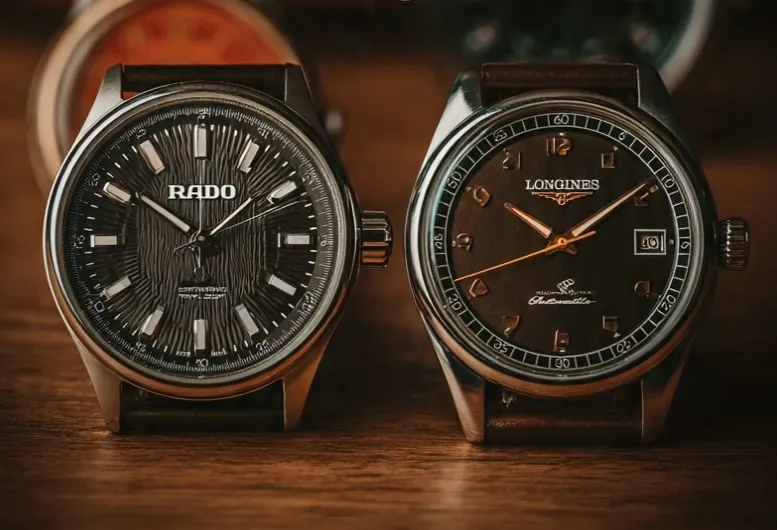
Let’s compare the specific flagship models you can buy right now to see how Rado vs Longines plays out in the real world.
Longines HydroConquest: The Dive Watch Choice
The HydroConquest remains one of the most popular entry-level luxury dive watches, updated for 2026 with refined proportions and new colors.
| Feature | Longines HydroConquest (2026) |
|---|---|
| Case Material | 316L Stainless Steel |
| Case Sizes | 39mm and 42mm |
| Thickness | 11.7mm |
| Water Resistance | 300 meters (30 bar) |
| Bezel | Unidirectional with Ceramic Insert |
| Movement | Calibre L888.5 (Silicon Balance Spring) |
| Power Reserve | 72 Hours |
| Price (USD) | ~$2,200 – $2,400 |
| Price (India) | ₹1,50,000 – ₹2,60,000 |
The 2026 HydroConquest is available in 39mm and 42mm sizes, with a slim profile of 11.7mm. It features a unidirectional rotating bezel with a scratch-resistant ceramic insert. A highlight of 2026 is the Commonwealth Games Limited Edition, featuring a stunning gradient teal-to-black dial. This edition is limited to 2,026 pieces per size and includes a special engraved case back. For travelers, the HydroConquest GMT offers a “true” GMT complication, allowing you to track a second time zone independently, priced around $3,350.
Rado Captain Cook: The Retro Diver
The Captain Cook reimagines a 1960s classic with modern High-Tech Ceramic, offering a completely different wearing experience.
| Feature | Rado Captain Cook High-Tech Ceramic |
|---|---|
| Case Material | Monobloc High-Tech Ceramic |
| Case Sizes | 42mm and 43mm |
| Weight | 114g – 159g (on bracelet) |
| Water Resistance | 300 meters (ISO 6425) |
| Bezel | Monobloc Ceramic |
| Movement | Rado R808 / R801 |
| Power Reserve | ~59 – 80 Hours |
| Price (USD) | ~$2,500 – $6,500 (Chrono) |
| Price (India) | ₹2,20,000 – ₹5,30,000 |
The Rado Captain Cook stands out because of its monobloc ceramic case, meaning the entire case is carved from a single block of ceramic with no metal core. This makes it incredibly light, weighing between 114g and 159g, compared to the 180g of a steel Longines. The 2026 lineup includes a Chronograph version in “Maritime Navy Blue” with a plasma ceramic case that looks like grey metal but contains no metal at all. Unlike the Longines, the Rado often features a titanium display case back, letting you view the movement, whereas the HydroConquest typically has a solid steel back.
Recent Post
- Apple Watch Series 12: Release Date, Price, Features, Specifications & Latest Rumors
- Oura Ring 5 vs HUAWEI WATCH D3: Which Wearable Is Right for You?
- HUAWEI WATCH D3 Review: Features, Specifications, Health Tracking & Price
- Timex Ironman Flix TW5M63000 Review: Price, Features, Specs & Is It Worth Buying?
- Rado White Ceramic Square Watch: Price, Features, Specifications & Best Models
Price and Value: Which Holds Money Better?
If you plan to sell your watch in the future, the financial performance of Rado vs Longines is a critical factor to consider.
Resale Value and Liquidity
Longines is the undisputed winner when it comes to retaining value and selling quickly.
Data from the secondary market shows that Longines is a “known quantity.” A used HydroConquest in good condition typically retains 60-70% of its original retail price. Because the brand is so famous, these watches sell quickly on platforms like eBay and Chrono24. Models from the Heritage and Master Collections are particularly stable investments.

Rado, conversely, suffers from higher initial depreciation. A new ceramic Captain Cook might lose 40-50% of its value immediately upon purchase. This is partly because ceramic watches are harder to size (requiring special tools to add/remove links), which limits the pool of buyers. However, there is a “condition bonus” for Rado. While a 5-year-old steel Longines will have visible scratches that lower its price, a 5-year-old Rado will look brand new. This perfect condition helps Rado stabilize its price floor in the long run, even if the initial drop is steeper.
Buying Price Comparison
In terms of entry price, both brands are accessible, but Rado’s ceramic models command a premium for the material technology.
- Longines: Entry-level automatic models start around $2,200 USD. In India, prices range from ₹1,50,000 for standard models to ₹3,80,000 for the Spirit Zulu Time.
- Rado: Entry-level quartz models start lower, around ₹87,700 in India. However, the core automatic ceramic models start around ₹2,49,100 and can reach ₹6,89,400 for complex editions like the Captain Cook Chronograph.
Warranty and After-Sales Service
When spending thousands on a timepiece, the warranty coverage provides peace of mind and reflects the brand’s confidence in its product.
Longines Warranty Policy
Longines offers a tiered warranty system that rewards buyers of their newer, high-tech movements.
Every new Longines watch comes with a standard 2-year international warranty covering manufacturing defects. However, for models equipped with the new silicon balance spring (like the L888.5 found in the 2026 HydroConquest and Master Collection), this warranty is automatically extended to 5 years. This extension is a major selling point, effectively doubling the coverage period for their most advanced watches.
Rado Warranty Policy
Rado provides a straightforward and generous warranty that covers all their watches equally, regardless of the movement type.
Rado offers a flat 5-year international warranty on all its watches from the date of purchase. This demonstrates their confidence in the durability of their High-Tech Ceramic and their in-house movements. It is worth noting that while the warranty covers defects, physical damage to a ceramic case (like a crack from a hard impact) is often not covered and can be difficult to repair, sometimes requiring a full case replacement. Steel cases on Longines watches are generally easier and cheaper to polish or repair if damaged.
My Final Thought : Who Should Buy What?
The winner of Rado vs Longines depends entirely on your personal priorities and how you plan to use the watch.
Choose Rado If:
- You hate scratches: If you want a watch that looks brand new forever, Rado’s ceramic is the gold standard.
- You have sensitive skin: The hypoallergenic ceramic is smooth and gentle on the wrist.
- You prefer lightweight comfort: The Rado Captain Cook is significantly lighter than steel competitors.
- You love unique design: The plasma ceramic finish looks like metal but is technically advanced and unique.
- You plan to keep it forever: If you aren’t planning to sell soon, the initial depreciation doesn’t matter; you get a timeless, durable object.
Choose Longines If:
- You care about resale value: Longines is the safer financial bet, retaining value better and selling faster.
- You want a traditional look: If you prefer the classic weight and feel of stainless steel.
- You travel often: The HydroConquest GMT and Spirit Zulu Time offer excellent dual-time zone features.
- You want proven technology: The silicon balance spring offers superior anti-magnetic protection and a 72-hour power reserve.
- You are a “rational investor”: Longines appeals to those who want a known quantity with stable market performance.
Limitations & Unknowns
While this report uses the latest available data for 2026, specific water resistance testing protocols for individual units can vary by manufacturer batch and are not publicly detailed beyond ISO standards. Additionally, resale value projections are based on current market trends and can fluctuate based on economic conditions and collector demand in late 2026. Exact case dimensions for every single variant (especially limited editions) should be verified with an authorized dealer before purchase, as minor variations can occur.