
The Omega Seamaster secures its status as a premier luxury timepiece through a unique synthesis of Master Chronometer precision (0 to +5 seconds/day), extreme anti-magnetic resistance (15,000 gauss), and professional-grade durability proven by record-breaking dives to 10,928 meters. While the iconic Diver 300M offers a versatile 42mm profile that wears comfortably on a 7-inch wrist due to its curved lugs, potential buyers must navigate significant grey market discounts (up to 36% off retail) and be aware of legibility challenges caused by reflective ceramic dials in direct sunlight. Ultimately, the Seamaster represents a high-value entry into high horology, provided one purchases on the secondary market to mitigate immediate depreciation.
Engineering Excellence and Movement
The core argument for the Omega Seamaster lies in its technical superiority, specifically the transition from standard COSC certification to the rigorous METAS Master Chronometer standard.
The Master Chronometer Advantage
Unlike standard Swiss certifications that allow a variance of -4 to +6 seconds per day, the Co-Axial Master Chronometer Calibre 8800 found in modern Diver 300M models is certified to maintain accuracy between 0 and +5 seconds per day. This precision is maintained even when exposed to magnetic fields up to 15,000 gauss, a level of resistance that renders the watch immune to the magnetic interference of daily electronics (laptops, speakers, MRI machines) that would halt a standard mechanical movement. In practical testing, these movements often exhibit a “delta” (variation between positions) as low as 3.1 seconds, indicating exceptional positional stability.
For those prioritizing low maintenance, the quartz variants powered by the Calibre 1538 offer a robust alternative with a verified battery life of 42 months. These models include a practical End of Life (EOL) indicator, where the second hand jumps in 4-second intervals to signal the need for replacement, preventing leakage damage.
Build Quality and Water Resistance
The Seamaster Diver 300M is built to ISO 22810:2010 standards for diving watches, featuring a helium escape valve at the 10:00 position. While often debated aesthetically, this valve is a functional requirement for saturation diving, allowing trapped helium to escape during decompression without shattering the crystal. The case construction utilizes a mix of stainless steel, 18K Sedna Gold™, and high-tech ceramic, materials chosen for their resistance to fading and scratching. The signature laser-engraved wave dial and scalloped bezel are not merely decorative; they are hallmarks of a design language that has remained consistent since the 1990s, ensuring immediate recognizability.
Real-World Wearability and Dimensions
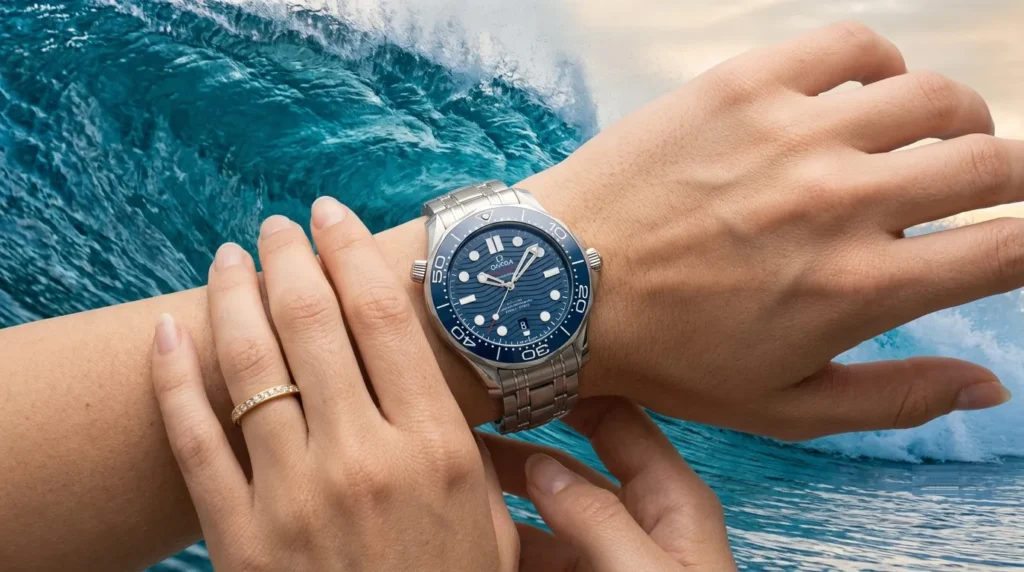
Technical specs matter little if a watch does not fit the wrist. The Omega Seamaster Diver 300M presents a specific ergonomic profile that differs from its paper specifications.
Lug-to-Lug Fit and Wrist Presence
Despite a case diameter of 42mm, the Seamaster Diver 300M features a lug-to-lug measurement of approximately 49mm to 50mm. Crucially, the “twisted lyre” lugs curve downward sharply, allowing the watch to wrap around the wrist rather than spanning it flat.
- On a 7-inch wrist: The watch wears comfortably, visually appearing closer to a 40mm timepiece due to the lug curvature.
- On smaller wrists (<6.5 inches): The 49mm span can feel substantial, potentially overhanging slightly, making the 38mm Aqua Terra or vintage 34mm models more suitable alternatives.
- Thickness: At 13.6mm to 13.8mm thick, it slides under a dress shirt cuff with minor resistance, though it is noticeably thicker than dress-specific models.
Weight and Comfort Dynamics
Weight is a defining characteristic of the steel Seamaster. A full steel Diver 300M on the bracelet weighs approximately 171g to 178g.
- The Clasp Factor: The “massive” butterfly clasp with the diver’s extension contributes significantly to this heft. While the extension is excellent for wearing over a wetsuit, the lack of micro-adjustments on older or specific clasps can make finding the perfect “sweet spot” difficult.
- Top-Heavy Feel: Some users report the watch feels “top-heavy,” particularly when the bracelet is loose.
- Titanium Alternative: For those sensitive to weight, the Planet Ocean Titanium models offer a drastically reduced weight of roughly 131g to 137g, providing a much lighter daily wear experience without sacrificing durability.
Legibility in Real-World Conditions
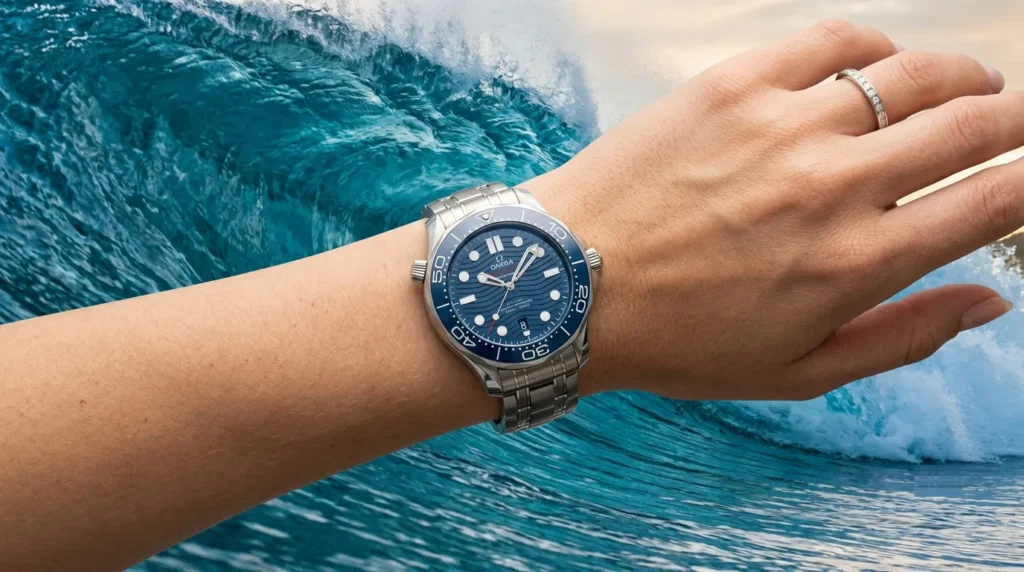
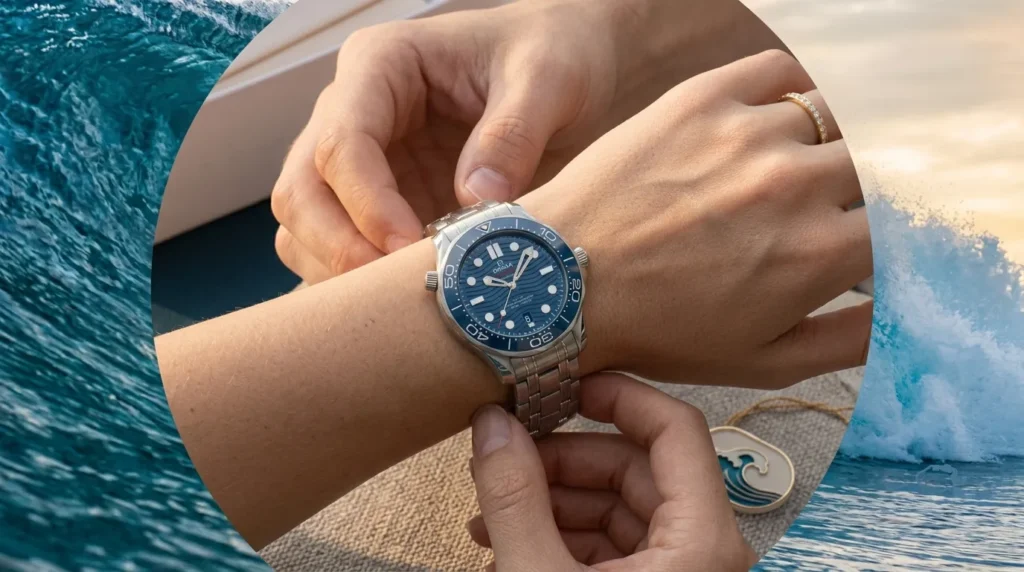
Legibility is a mixed bag depending on lighting. The ceramic dial, while stunning in indoor lighting, is “very, very reflective” in direct sunlight.
- Sunlight Performance: In bright conditions, the glossy wave pattern can create glare that obscures the hands, a issue noted specifically in the No Time To Die edition which lacks external anti-reflective coating on the crystal.
- Underwater: The skeletonized hands on some Diver 300M models have been critiqued for being less legible in murky water compared to the bold, blocky hands of the Planet Ocean.
- Lume: The Super-LumiNova application is generous, charging quickly in sunlight and remaining bright for 8-10 hours, ensuring nighttime readability is excellent.
Market Analysis and Pricing Anchors
Buying an Omega Seamaster requires navigating a complex pricing landscape where MSRP rarely reflects the actual street value.
Price Anchors: Low, Median, and High
Based on aggregated data from realized sales and current listings as of July 2026:
| Model Reference | Low (Sold/Used) | Median (Market) | High (Ask/Retail) | Notes |
|---|---|---|---|---|
| Diver 300M Steel (210.30.42.20.01.001) | $4,200 | $4,286 | $5,400 | Grey market discounts up to 36% |
| Aqua Terra 150M (38.5mm Steel) | $3,500 | $3,895 | $6,800 | Grey market discounts up to 42% |
| Planet Ocean 600M (Steel) | $4,500 | $5,200 | $10,000+ | Higher retention than Diver |
| Diver 300M Titanium (210.90.42.20.01.001) | $5,800 | $6,500 | $7,377 | Premium for lightweight material |
| Vintage Seamaster (1960s) | $1,400 | $2,250 | $2,750 | Highly variable by condition |
Prices based on realized sales (eBay sold/auctions) vs. current listings (Chrono24/Grey Market).
Value Retention and Depreciation
It is critical to note that Omega watches generally do not hold their value at retail price immediately after purchase.
- Initial Hit: Buying new from an Authorized Dealer often results in an immediate 15-25% loss in value once the watch leaves the store.
- Secondary Market Liquidity: Despite depreciation, the market is highly liquid. Buy-side desks readily acquire Seamasters within 20–40% of original retail, ensuring you can exit the position if needed.
- Exceptions: Specific limited editions (e.g., Spectre, No Time To Die) and vintage references from the 1950s-1960s have shown appreciation, with some vintage models seeing 1-year performance gains of over 20%. However, the standard blue Diver 300M is a stable holder rather than a high-growth asset, with pre-owned values increasing modestly (~15%) over five years.
Critical Assessment: The Negatives
To maintain editorial independence, specific flaws in the Omega Seamaster must be acknowledged. These are not dealbreakers for everyone, but they are tangible drawbacks.
- Reflective Dial Glare: The glossy ceramic dial, a signature of the model, is a double-edged sword. In direct sunlight or underwater with certain lighting angles, the reflection can be blinding, making time-telling difficult compared to matte-dial competitors.
- Weight and Bulk: At ~178g, the steel bracelet version is heavy. Combined with a thick case and a large clasp, it can feel “clunky” on smaller wrists or during sleep. The crown guards can also dig into the back of the hand for some users.
- Bezel Grip: While the ceramic bezel insert is scratch-proof and precise (“zero back play”), the ridged edge can be difficult to grip, especially with wet hands or when wearing the factory rubber strap which sits flush against the case.
- Retail Value Proposition: Paying full MSRP is financially inadvisable given the pervasive grey market discounts. The value proposition only truly shines when purchased pre-owned or via authorized grey market dealers.
Model Comparison and Buying Guide
When selecting a Seamaster, the choice depends heavily on your specific use case. The following table compares the primary variants against key metrics.
Comparison Table
| Feature | Seamaster Diver 300M | Planet Ocean 600M | Aqua Terra 150M | Vintage Seamaster (1960s) | Seamaster Quartz |
|---|---|---|---|---|---|
| Price (Realized) | $4,200 – $4,800 | $4,500 – $5,500 | $3,500 – $4,200 | $1,400 – $2,750 | ~$2,500 |
| Case Size | 42mm (49mm L2L) | 43.5mm (52mm L2L) | 38-41mm | 34-36mm | 36.25mm |
| Movement | Auto (Cal. 8800) | Auto (Cal. 8900) | Auto (Cal. 8802) | Manual/Auto (Cal. 500/600) | Quartz (Cal. 1538) |
| Water Resistance | 300m | 600m | 150m | ~60m (Historical) | 300m |
| Best For | Daily Dive/Office | Serious Diving/Tool | Dress/Sport Hybrid | Collectors/Style | Low Maintenance |
Where to Buy and Authentication
Authorized Dealers (ADs) are the safest route for warranty coverage (typically 5 years for Master Chronometers) and brand-new pieces. However, for value, trusted grey market resellers are superior.
- Protections to Look For: Ensure the reseller offers authenticity escrow (third-party verification) and a minimum 14-day return policy.
- Authentication Tips:
- Weight: Fakes are often noticeably lighter than the substantial 171g+ of a genuine steel model.
- Movement: Genuine automatics have a smooth sweeping second hand; fakes often tick once per second (unless high-end clone).
- Magnetism: Post-2014 models are anti-magnetic. If a modern Seamaster stops or loses time near a magnet, it is likely a fake.
- Lume: Genuine lume is bright, even, and covers large areas on hands/markers. Fakes often have thin, uneven application.
Conclusion and Recommendation
The Omega Seamaster earns its place as one of the world’s best luxury watches by offering a level of technical certification (Master Chronometer) and build quality that rivals or exceeds competitors at a significantly lower entry price point—if bought wisely. It is a watch that bridges the gap between a rugged tool and a refined accessory, capable of surviving a 300m dive while looking appropriate in a boardroom.
Who This Is For
- The Technical Enthusiast: You value the 0 to +5 seconds/day accuracy and 15,000 gauss anti-magnetic resistance above brand prestige alone.
- The Versatile Wearer: You need a single watch that can handle swimming, hiking, and black-tie events (especially the Aqua Terra or Diver on a rubber strap).
- The Value-Conscious Buyer: You are willing to buy pre-owned or from the grey market to avoid the initial depreciation hit, securing a high-end Swiss watch for ~$4,200.
Who This Is NOT For
- The Small-Wristed: If your wrist is under 6.5 inches, the 49mm lug-to-lug span of the Diver 300M may be too large; consider the Aqua Terra 38mm instead.
- The Flipper: Unless buying rare vintage pieces or limited editions, do not expect immediate appreciation on retail purchases.
- The Glare-Sensitive: If you spend extensive time in direct sunlight, the reflective ceramic dial may frustrate you.
The Omega Seamaster is a 4.5/5 masterpiece. It loses half a point for the reflective dial and heavy steel bracelet, but gains full marks for movement technology and overall value. It remains the benchmark for what a modern luxury sports watch should be.
1 thought on “Why the Omega Seamaster Is One of the World’s Best Luxury Watches”